Golf cart owners face a common problem. You want to upgrade to lithium technology, but your battery compartment wasn’t built for it. Standard lithium batteries are too big, and rebuilding the compartment costs a fortune. The Vatrer 48V 105Ah Mini Lithium Battery solves this with a smaller footprint that actually fits.
At 13.19 x 12.2 x 10.04 inches, this battery slides into spaces where regular lithium options won’t go. But here’s what matters more: it still delivers 5,376Wh of usable energy. That translates to roughly 50 miles per charge, depending on how you drive and what terrain you cover. You can play 36 holes without worrying about running out of power halfway through your second round.
- Power Output That Handles Real-World Demands
- Cold Weather Protection Built into the Design
- Monitor Everything from Your Phone or the LCD Screen
- Fast Charging Gets You Back on the Course Quickly
- Complete Installation Kit with All Necessary Components
- Long-Term Ownership Costs Less Than Lead-Acid
- Practical Considerations Before Purchase
- Who Gets the Most Value from This Battery
- Making the Investment Decision
Power Output That Handles Real-World Demands
The mini battery doesn’t compromise on performance despite its compact size. It handles situations that would drain or damage lesser batteries.
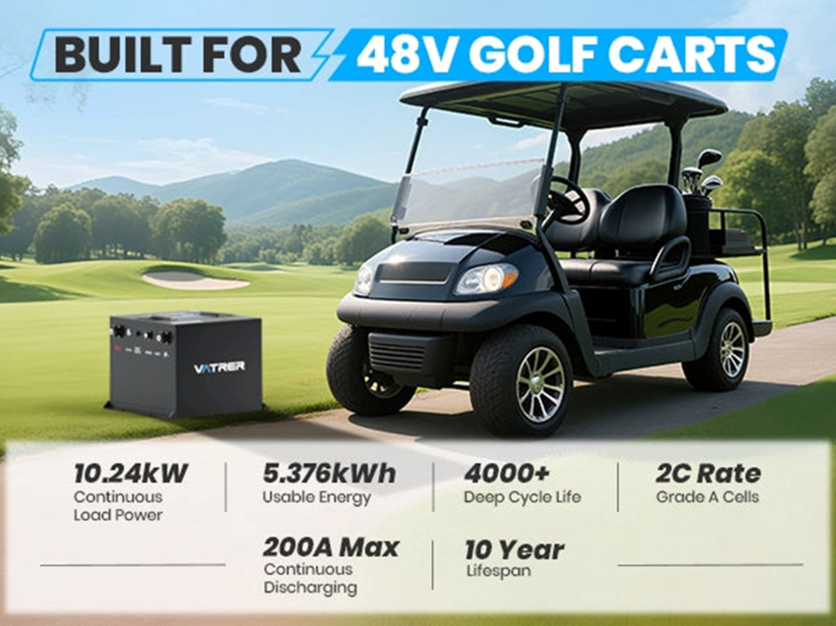
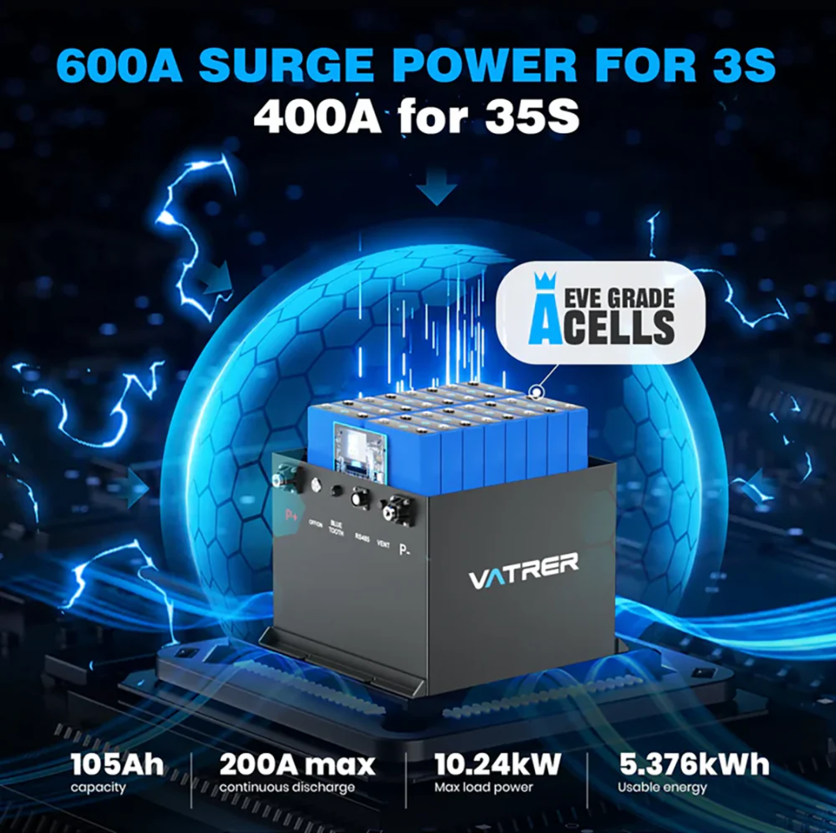
The continuous discharge rating sits at 200A, which supports 10.24kW of power output. This matters when you’re climbing hills with a full load of passengers and golf bags. The battery also handles peak demands of 400A for 35 seconds or 600A for 3 seconds. These bursts cover hard acceleration from a standstill or pushing through sandy patches on the course. This makes the mini lithium battery reliable even under demanding conditions.
The voltage curve stays flat through most of the discharge cycle. Vatrer lithium batteries maintain consistent voltage until around 20% capacity, so your cart runs at full speed whether you’re at 90% charge or 30%. Lead-acid batteries lose voltage gradually, causing the cart to slow down as power drops.
While lithium batteries support 100% complete discharge, discharging to 20% before recharging helps extend overall battery life. This doesn’t mean the battery can only discharge to 80%. You have full access to all capacity when needed, but stopping at 20% for regular use maximizes the number of cycles you’ll get over the battery’s lifetime.
The built-in 200A Battery Management System monitors everything happening inside the battery. It tracks voltage, current flow, and temperature across all cells. If something goes wrong, the BMS cuts power immediately. Overcharging stops before cells get damaged. Over-discharging protection prevents the deep drain that kills battery capacity. Short circuit protection activates in milliseconds if wires cross or connections fail.
Vatrer 48V 105Ah Mini Lithium Battery
Vatrer
Cold Weather Protection Built into the Design
Winter creates specific problems for lithium batteries. Charging a cold lithium cell can cause permanent damage through lithium plating on the anode. Most people don’t know this until they’ve already ruined an expensive battery.
Vatrer addresses this with automatic temperature cutoffs. Here’s how it works in practice:
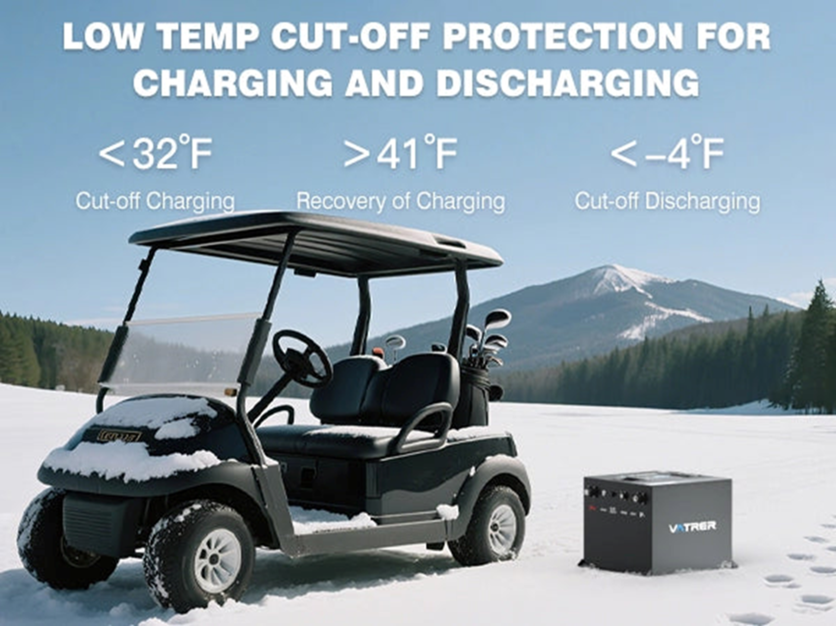
- Charging protection: The system stops accepting a charge below 32°F. Once the battery warms above 41°F, charging resumes automatically. You don’t need to do anything.
- Discharge protection: Power output cuts off at -4°F to prevent cell damage. This protects the battery during extreme cold snaps.
- No manual intervention needed: The BMS handles everything. You can’t accidentally damage the battery by plugging it in on a freezing morning.
For golf courses in northern climates, this protection matters. You won’t destroy your battery during early spring or late fall rounds when temperatures drop overnight. The system simply waits for safe conditions before charging begins.
Vatrer
Monitor Everything from Your Phone or the LCD Screen
Guessing the remaining charge becomes a thing of the past with dual monitoring options. The included 2.8-inch LCD touchscreen mounts on your cart and shows real-time data. You see voltage, current draw, state of charge percentage, and internal temperature at a glance.
The Vatrer mobile app adds remote monitoring through Bluetooth. Check battery status from anywhere within range. The app displays the same information as the LCD screen but lets you review historical data. You can track charging patterns over weeks or months, which helps predict when maintenance might be needed.

Vatrer
Fleet operators find this particularly useful. Managing ten or twenty carts means checking each one individually without monitoring. With the app, you can review all batteries from one device and spot problems before they strand a cart on the course.
The screen and app both update in real time. You watch the state of charge climb during charging or see the current draw increase when climbing a hill. This visibility helps you understand how driving habits affect battery life and range.
Fast Charging Gets You Back on the Course Quickly
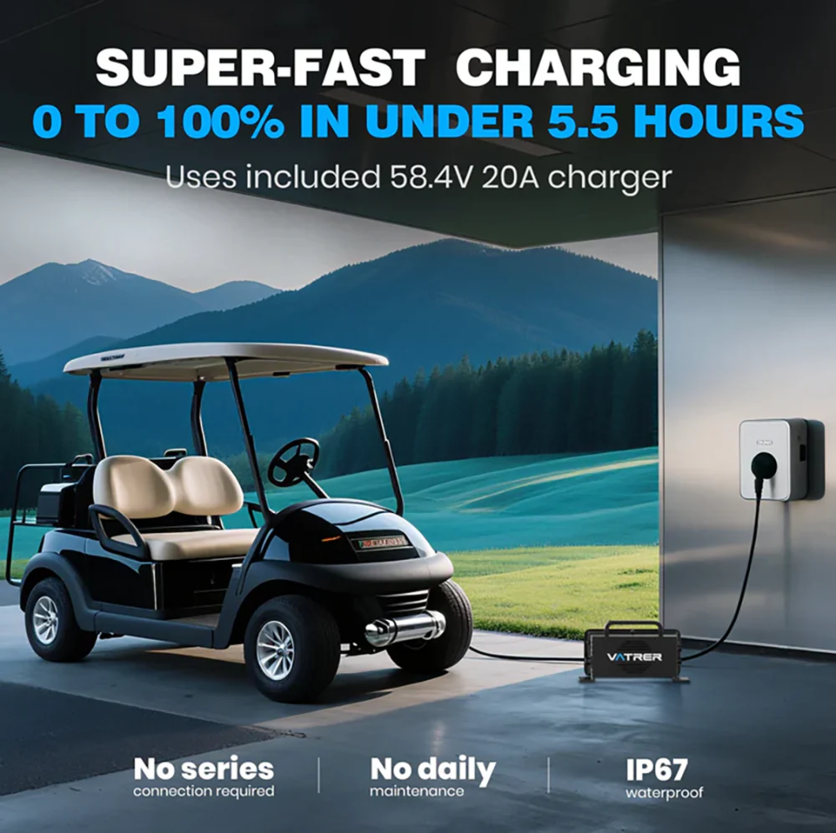
The included 58.4V 18A LiFePO4 charger fills the battery from empty to full in 6 hours. Compare this to lead-acid batteries that often need 8–12 hours for a complete charge. You can finish a morning round, plug in over lunch, and have enough charge for an afternoon outing.
The charger uses a three-stage charging profile designed specifically for LiFePO4 cells. It starts with constant current charging at full power, switches to constant voltage as the battery approaches full capacity, and finishes with a float stage that balances individual cells. This process maximizes battery life while preventing the overheating that shortens lifespan.
Multiple carts can charge overnight from standard household outlets. The 20A charger draws about 1,200 watts at peak, which any normal 15A circuit handles easily. No special electrical work required unless you’re charging several carts simultaneously.
If using an extension cord, similar to a power strip, it is recommended that the current rating of the extension cord be greater than 15A; otherwise, it may easily lead to overheating and other dangerous situations.
Vatrer
Complete Installation Kit with All Necessary Components
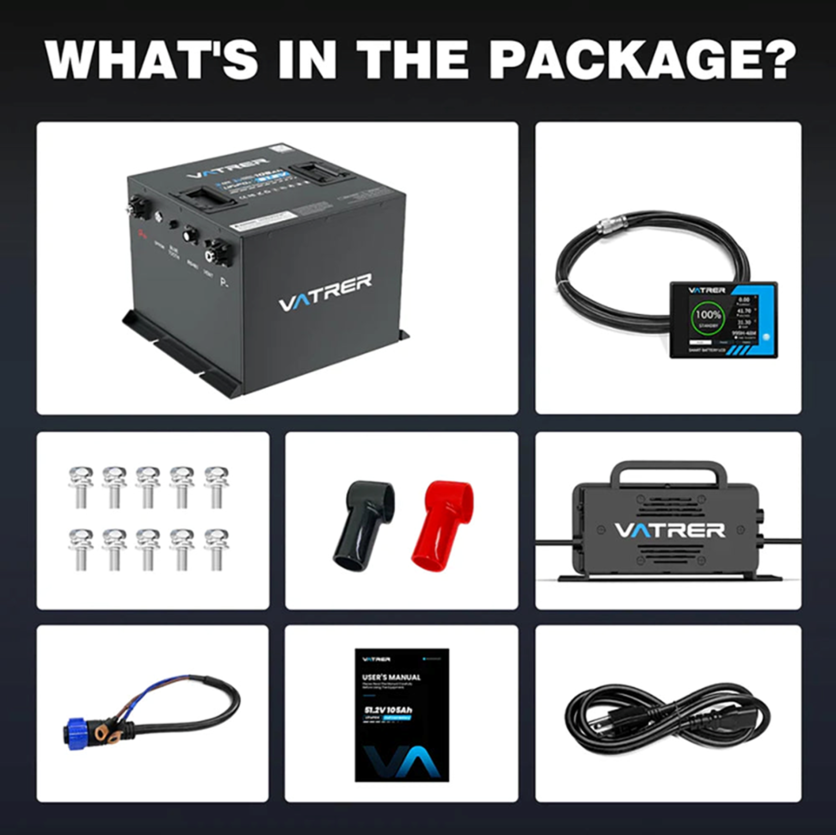
Everything you need comes in the box. The complete kit includes:
- 48V 105Ah mini lithium battery
- 58.4V 20A LiFePO4 charger
- 2.8-inch LCD touchscreen with mounting hardware
- Connection cables and monitor cable
- Mounting brackets and all necessary screws
- Detailed installation manual
Most people complete the installation in 30–60 minutes. The battery weighs 90.57 pounds, so having a second person helps with positioning. Integrated carrying handles on each end make lifting and placement easier.
The plug-and-play design works with Club Car, EZGO, Yamaha, and most other 48V golf cart controllers. You connect the main power cables to your controller, mount the LCD screen where you can see it, and run the monitor cable between them. The SPCC steel casing protects internal components from impacts and vibration that golf carts experience on rough terrain.
Vatrer
Older carts might need a charger upgrade if you’re still using the original lead-acid charger. Lead-acid and lithium batteries require different charging profiles. Using the wrong charger damages the battery or creates safety hazards. The included LiFePO4 charger eliminates this concern and is designed specifically for Vatrer lithium golf cart batteries.
Long-Term Ownership Costs Less Than Lead-Acid
The Vatrer 48V lithium battery handles over 4,000 charge cycles while retaining 80% of its original capacity. Under typical golf cart use, this translates to 8–10 years of service. Lead-acid batteries typically last 300–500 cycles, or about 1–2 years with regular use.
Over a decade, you would replace lead-acid batteries four or five times. Even budget lead-acid batteries cost several hundred dollars each, so the total replacement cost exceeds the upfront lithium investment. Add in the time spent removing old batteries, disposing of them properly, and installing new ones, and lithium becomes clearly more cost-effective.
Maintenance requirements drop to nearly zero. Lead-acid batteries need regular water additions, terminal cleaning, and equalization charging. Lithium batteries require none of this. Check connections periodically to ensure they’re tight and clean. That’s it.
Weight reduction improves cart performance across the board. The mini battery weighs roughly half what equivalent lead-acid batteries weigh. Removing 80–100 pounds from your cart improves acceleration, increases range per charge, and reduces stress on suspension components. Tires last longer, and the cart handles better on turns.

Vatrer
Practical Considerations Before Purchase
The 105Ah capacity works well for standard golf carts in typical conditions. Heavily modified carts face different demands. If you’ve added a lift kit, oversized tires, upgraded motor, or multiple accessories like speakers and lights, power consumption increases significantly. You might find the 105Ah capacity limiting for all-day use.
The Vatrer 150Ah version offers more reserve capacity for modified carts or situations requiring extended runtime. Evaluate your actual usage patterns before deciding. Track how far you typically drive between charges and whether you’re pushing the limits of your current setup.
Older golf carts sometimes require upgrades beyond just the battery and charger. Because some older models are not directly compatible with lithium batteries for plug-and-play operation, wiring modifications may be necessary. To ensure your cart is compatible with Vatrer lithium batteries, we recommend contacting our technical support team at [email protected] before purchasing, providing your cart’s brand, model, and year to confirm compatibility.
Winter storage requires minimal attention but shouldn’t be ignored completely. Keep the battery between 40–80% charge when storing for extended periods. Store in a cool, dry location away from temperature extremes. The low self-discharge rate means the battery holds a charge for months without attention, unlike lead-acid batteries that need monthly maintenance charging to prevent sulfation.
Vatrer
Who Gets the Most Value from This Battery
Golf cart owners with space-constrained battery compartments get the most obvious benefit. Some models, such as older Club Car DS and Yamaha G-series golf carts, may not be able to directly install standard lithium batteries and require wiring modifications. If you are unsure, please consult the Vatrer technical team at [email protected].
Fleet managers running multiple carts appreciate the reduced maintenance and longer lifespan. Less time spent on battery maintenance means more time available for other tasks. Fewer battery replacements reduce both parts costs and labor. The monitoring capability through the app lets managers track individual cart performance and catch problems early.
Weekend golfers and recreational users get reliable, consistent performance. The 50-mile range handles multiple rounds or several days of neighborhood driving between charges. Fast charging means you’re not tied to overnight charging schedules. Plug in for a few hours, and you’re ready to go.
Making the Investment Decision
Compare the total cost of ownership rather than just the sticker price. The Vatrer mini battery costs more upfront than lead-acid batteries. Over its 8–10 year lifespan, it costs less than the four or five lead-acid replacements you would buy during the same period. Factor in the time saved on maintenance, improved cart performance, and increased range per charge.
Current promotions make the upgrade more accessible. Use discount code VPRIME at checkout for additional savings. First-time buyers earn reward points toward future purchases and receive priority shipping.
The 48V 105Ah mini battery fills a specific gap in the golf cart battery market. It brings modern lithium technology to carts that couldn’t previously accept it due to space limitations. For cart owners who want lithium performance but can’t fit standard batteries, this compact option delivers the range, power, and longevity that make the upgrade worthwhile.